
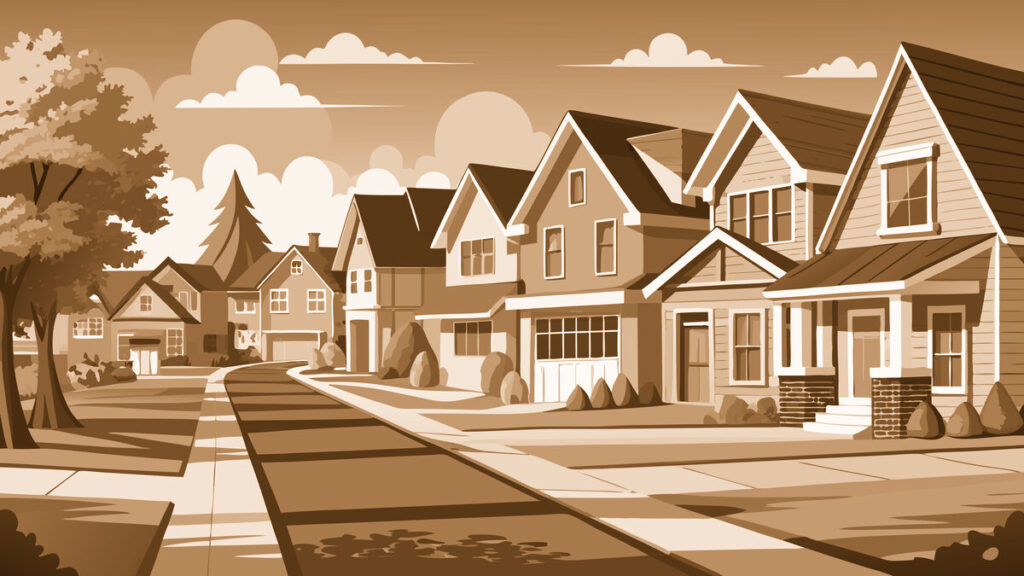
A Small Neighborhood With a Larger Story
Regan Mead Way is one of those quiet residential streets that can be easy to overlook on a map but memorable once you have spent time there. Located in The Woodlands’ Village of Sterling Ridge, near Branch Crossing Drive and Woodlands Parkway, the neighborhood belongs to the newer westward chapters of The Woodlands story.
Its appeal is not built around a grand historic courthouse or a century-old downtown block. Instead, Regan Mead Way reflects the community’s more modern heritage: carefully planned streets, neighborhood parks, mature trees, nearby schools, and a daily life shaped by the idea that nature and development should coexist.
For longtime residents, the neighborhood feels like a natural extension of the larger Woodlands experiment—one that began with an ambitious question: Could a growing community preserve the character of the Piney Woods while still offering comfortable homes, schools, workplaces, shops, and recreation?
Before Regan Mead Way: The Land Beneath The Woodlands
Long before Regan Mead Way was built, the land belonged to a much larger forested landscape connected to Montgomery County’s timber history. The region around present-day The Woodlands was associated with the lumber industry, including the Grogan-Cochran Lumber Company. George P. Mitchell began acquiring land in the 1960s, including approximately 2,800 acres connected to the former lumber operation. Over the next decade, additional purchases brought the overall property to more than 20,000 acres. ([thewoodlands.com](https://www.thewoodlands.com/community/history/?utm_source=openai))
Mitchell formally launched The Woodlands in 1974. His vision was more ambitious than a conventional subdivision. He wanted a complete community with housing, schools, business districts, shopping, cultural venues, parks, and preserved open space. The first village, Grogan’s Mill, opened that year, followed by Panther Creek, Cochran’s Crossing, Indian Springs, Alden Bridge, College Park, Sterling Ridge, Carlton Woods, and Creekside Park over the following decades. ([thewoodlands.com](https://www.thewoodlands.com/community/history/?utm_source=openai))
Regan Mead Way arrived during the expansion of Sterling Ridge, a village that began developing in the late 1990s. In that sense, the neighborhood is part of The Woodlands’ second-generation heritage—not among the original 1970s streets, but still shaped by the planning principles established at the beginning.
How Regan Mead Way Got Its Name
The exact inspiration for “Regan Mead” is not clearly documented in the public historical record, and that uncertainty is itself typical of The Woodlands. Many streets and neighborhood names were created as part of a coordinated naming program rather than inherited from an older town grid.
The Woodlands’ street names often draw from literature, music, art, nature, geography, and carefully selected combinations of words. Naming leaders such as Susan Vreeland-Wendt helped develop hundreds of names, sometimes using themes specific to a village or neighborhood. Main roads were frequently connected to village identities, while smaller streets could carry more imaginative or poetic names. ([houstoniamag.com](https://www.houstoniamag.com/news-and-city-life/2017/10/street-names-the-woodlands?utm_source=openai))
“Regan Mead” has the soft, pastoral quality common to many Woodlands names. “Mead” suggests a meadow or open green place, while “Regan” gives the name a personal, almost storybook character. Whether it honors a person, draws from a literary reference, or was simply selected for its sound, the name fits a community designed to feel settled, welcoming, and connected to the landscape.
The Neighborhood Takes Shape
Regan Mead and Regan Mead Way were developed primarily in the early 2000s, when Sterling Ridge was growing rapidly west of the older villages. Available neighborhood records identify home construction in Regan Mead beginning around 2004 and 2005, with builders including Lennar and Emerald/DR Horton. ([woodlandsre.wordpress.com](https://woodlandsre.wordpress.com/category/area-neighborhoods/woodlands/sterling-ridge-village/regan-mead/?utm_source=openai))
The homes helped fill an important niche in The Woodlands. Rather than focusing only on large estate properties, the neighborhood offered practical single-family houses with a mix of one-story and two-story designs. Streets such as Regan Mead, Regan Mead Circle, and nearby residential lanes were laid out in the familiar Woodlands pattern, with curving roads, cul-de-sacs, landscaped verges, and connections to parks and pathways.
Residents were also drawn by proximity to Coulson Tough Elementary School, the South Montgomery County Family YMCA at Branch Crossing, and the George and Cynthia Woods Mitchell Library. These institutions helped turn what might have been a collection of new houses into a recognizable neighborhood community.
Parks, Paths, and Everyday Landmarks
The most important landmarks around Regan Mead Way are not monumental buildings but the green spaces woven into everyday routines.
- Artist Grove Park offers a neighborhood-scale setting for play, informal gatherings, and evening walks.
- Cranebrook Park and Cranebrook Pool contribute to the family-oriented character of the surrounding area.
- Spindle Tree Ponds Park and Jogging Trail Park provides another nearby route for walking and outdoor exercise.
- George Mitchell Nature Preserve represents the larger conservation legacy of The Woodlands, protecting wooded land and natural habitat within the broader community.
- The George and Cynthia Woods Mitchell Library connects the neighborhood to education, reading, community programs, and the intellectual heritage of the Mitchell family.
These places show how The Woodlands’ original plan continues to influence Regan Mead Way. The community has more than 150 parks and more than 220 miles of pathways, with wooded buffers and open spaces intentionally preserved along roads and neighborhoods. ([thewoodlands.com](https://www.thewoodlands.com/community/history/?utm_source=openai))
Growing Into An Established Community
When the first Regan Mead homes were new, the surrounding landscape still had the feel of a developing edge. Woodlands Parkway and Branch Crossing connected residents to shopping, schools, and the village network, but many nearby trees and undeveloped parcels emphasized that Sterling Ridge was still growing.
Over the years, the neighborhood matured. Young trees became shade trees. Original homeowners renovated kitchens, replaced roofs, landscaped yards, and watched children grow up. Some properties changed hands, bringing new families and fresh routines to streets that had once been filled with construction traffic.
The neighborhood also became more connected to the wider life of The Woodlands. Town Center, Market Street, The Woodlands Waterway, the Cynthia Woods Mitchell Pavilion, and newer commercial areas made the community feel less like a distant suburb and more like a complete regional center. Market Street opened in 2005, while the Waterway developed into a recognizable destination linking dining, shopping, offices, entertainment, and public spaces. ([visitthewoodlands.com](https://www.visitthewoodlands.com/about/history/?utm_source=openai))
What Makes Regan Mead Way Special Today
Regan Mead Way is special because its history is both local and representative. It has its own streets, homes, parks, school routines, and neighborly memories, but it also carries the central promise of The Woodlands: live comfortably without losing touch with the forest.
A walk near Artist Grove Park or along the surrounding paths offers a reminder that this neighborhood was never meant to be just a housing tract. It was planned as part of a broader living environment where recreation, learning, nature, and daily errands fit together.
That is the heritage residents inherit today. Regan Mead Way may be a relatively young neighborhood, but its roots reach back to the timberlands, conservation ideals, and ambitious planning that shaped The Woodlands from the beginning. Its story is still being written—in shaded front yards, at nearby parks, beside the school pickup line, and along the quiet streets that give this corner of Sterling Ridge its enduring sense of home.